

The Dominican Republic is primarily associated with tourism: beaches, palm trees, hotels, and the Caribbean lifestyle. This image is true, but incomplete. Behind the tourist facade operates an economy that increasingly relies on agriculture, exports, local processing, and products important not only for the vacation landscape.
One such product is the coconut. For tourists, it is often a symbol of the Caribbean: a fruit from a beach photo, an ingredient in a hotel drink, or an element of exotic scenery. For the Dominican Republic, however, the coconut has a much more practical significance. It is part of the local economy: cultivation, jobs, local consumption, exports, and a raw material used in the food, cosmetics, and pharmaceutical industries.
How Is Coconut Production Growing in the Dominican Republic?
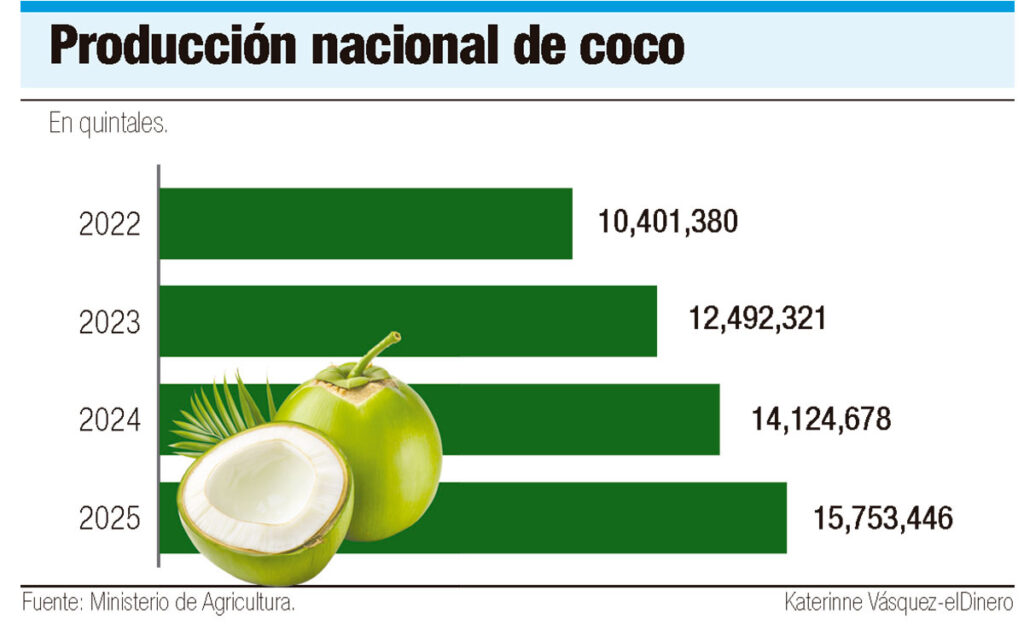
According to data from the Ministry of Agriculture, coconut production in the Dominican Republic has grown significantly in recent years. In 2022, it amounted to approximately 1.04 million tons. In 2023, it increased to approximately 1.25 million tons, in 2024 it reached approximately 1.41 million tons, and in 2025 it reached approximately 1.58 million tons. This means that over three years, the Dominican Republic increased coconut production by more than half a million tons. The strongest growth occurred in 2023, when production increased by 20.1% year-over-year. In 2024, growth was 13.1%, and in 2025 another 11.5%. This does not appear to be a one-time spike, but rather a sustained upward trend. Coconut is increasingly becoming one of the agricultural products that matter to the Dominican economy.
What Does Coconut Consumption Look Like in the Dominican Republic?
Data on domestic consumption is also important. In 2015, the Dominican Republic consumed approximately 780,000 tons of coconut. In 2023, this figure reached approximately 1.26 million tons. This represents a 60.3% increase over eight years. In absolute terms, domestic consumption increased by approximately 475,000 tons. The largest jump occurred in 2022, when coconut consumption increased by approximately 129,000 tons compared to 2021 and reached approximately 1.08 million tons. A year later, in 2023, consumption exceeded 1.26 million tons, representing a 16.9% year-over-year increase. These figures show that coconut in the Dominican Republic is not solely an export product. It is increasingly functioning in the domestic market as well—as a raw material, food product, and element of local consumption.
What Does Coconut Export from the Dominican Republic Look Like?
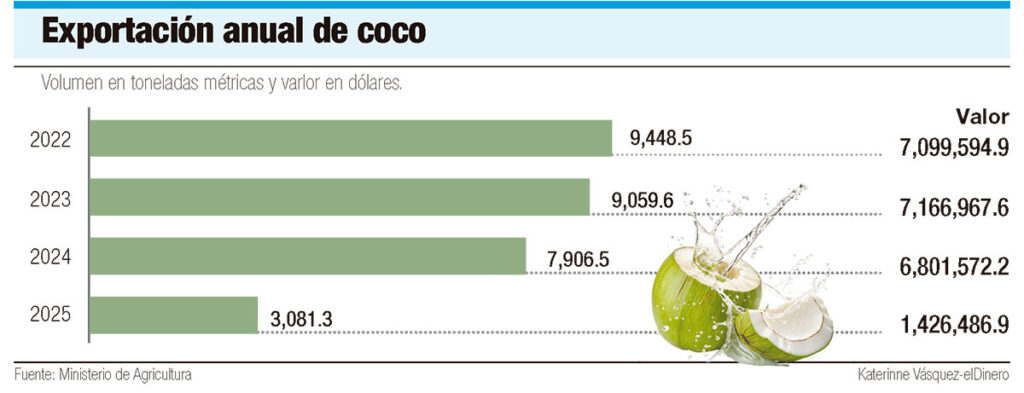
Coconut exports from the Dominican Republic appear less straightforward than production itself. In 2022, the country exported approximately 9,400 tons of coconut valued at $7.1 million. In 2023, volume declined slightly to approximately 9,100 tons, but export value increased to $7.2 million. In 2024, exports decreased to approximately 7,900 tons, and their value fell to $6.8 million. The largest decline came in 2025. Coconut exports amounted to approximately 3,100 tons, and their value dropped to $1.4 million. The main foreign sales destinations are the United States, Europe, and Haiti. At first glance, the data may be surprising: production is growing, consumption is growing, but exports are declining. This shows that higher production does not automatically mean greater sales abroad.
What Do Coconut Data Tell Us About the Dominican Economy?
This is a very interesting economic situation. On one hand, the Dominican Republic is increasing coconut production. On the other hand, local demand is growing so strongly that the country faces limitations in its own supply. According to the cited data, the popularity of coconut products means that domestic demand exceeds domestic production capacity. As a result, the Dominican Republic imports coconut from Guyana, Ivory Coast, and Ghana, among others.
Coconut demonstrates well that the Dominican Republic is not solely a country of hotels and tourism. Tourism remains one of the most important sectors of the economy, but alongside it, agriculture, production, exports, and an increasingly diversified domestic market are developing. This is important when we look at the Dominican Republic not only as a vacation destination, but as a country developing in several directions simultaneously.
From the perspective of the real estate market in the Dominican Republic, this also matters. A stable country cannot rely solely on seasonal tourist traffic. Jobs, local production, exports, investments, consumption, and the strength of the domestic market all count. The more diversified the economy, the greater the resilience to fluctuations in one sector.
Coconut may seem like a small topic compared to large hotel projects, new roads, airports, or tourism investments. But it is precisely such data that shows what is happening beneath the surface. The Dominican Republic does not only attract tourists. It produces, consumes, processes, and exports. And coconut is one of those products that clearly demonstrates that the Caribbean landscape can be not only a postcard, but also part of the economy.


